
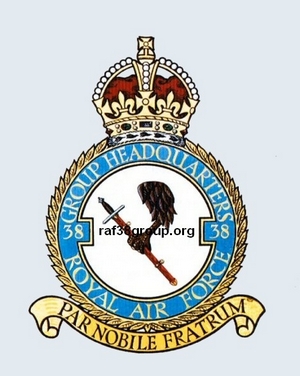
Badge: An eagle’s leg grasping a sword
Motto: ‘Par Nobile Fratrum’ – ‘A Noble Pair of Brothers’, symbolising the close association with the Army Airborne Forces
HISTORY
Squadron Code Letters ‘L5’ & ‘P5’.
On 15 December 1941 was formed, at RAF Ringway, the Parachute Exercise Squadron.
On 22 December 1941, the unit moved to RAF Netheravon where, on 22 January 1942, it was redesignated No.297 Squadron.
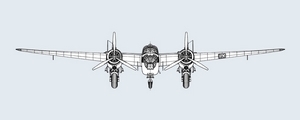
No.297 Squadron had collected its first Tiger Moth II aircraft on 15 January 1942 and the 2 first Armstrong Whitworth Whitley aircraft arrived on 06 February 1942 (13 Tiger Moth II and 7 Whitley V were allocated to the Squadron at the end of February 1942). The leaflet–dropping flights began on 10 October 1942 over France but also over Luxembourg and bombing operations began on 19 February 1943.
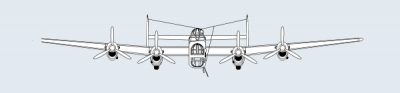
“C” Flight, which was formed on 16 July 1943, begun with 5 Armstrong Whitworth Albemarle aircraft soon, increased to 11.
By February 1944 the Squadron was completely equipped with Albemarles and flew supply-dropping flights to the resistance forces in France until ‘D-Day’.
June 1944:
At the start of this month, No.297 Squadron prepared for ‘D-Day’, Operation ‘OVERLORD’ at RAF Brize Norton along with No.296 Squadron.
First Operation of ‘OVERLORD’ for No.297 Squadron was ‘TONGA’. It was divided in 3 Phases. 24 Albemarles instead of 25 (V1778’s Glider went u/s and had to be released at base) flew this Operation where they had to take airborne troops of 6th Airborne Division, to Normandy before the landings.
Phase I, 4 pathfinder aircraft took off, plus 3 aircraft of No.296 Squadron. The very first No.297 Squadron aircraft, P1383 piloted by Warrant Officer Rickards (with on board a stick of 22nd Independent Para Coy) took off at 23:00 on 05 June 1944, plus one aircraft of No.296 Squadron at the same time. The 3 other No.297 Squadron aircraft carried each a stick of 10 men of the 5th Parachute Brigade who had to support the Pathfinders and to reinforce Major Howard’s company (see also No.298 Squadron History).
Phase II, 9 aircraft, plus 10 of No.296 Squadron (but 2 of No.296 went u/s), took off from 23:43 on 05 June (the first Albemarle of No.297 at 23:45). One of these Albemarles of No.297 Squadron was V1812 piloted by Squadron Leader Emblem (his last mission with the same crew can be read in Muneville part of the Site). On board was the main paratroops force of the 5th Parachute Brigade who had to drop on DZ ‘N’, near the East bank of the River Orne and to reinforce the men dropped on Phase I.
Phase III, 8 Albemarles instead of 9 (V1778’s Glider was u/s) followed from 01:10 on 06 June, plus 8 of No.296 Squadron, with the main glider force to be cast off near the DZ N. In these Gliders towed by No.297 were 5 Gliders with troops of 5th Parachute Brigade and 2 Gliders with Royal Engineers (V1778’s Glider should also have carried Royal Engineers).
But Phase III was not finished: 3 more Albemarles took off from 02:30 with reinforcements (troops of A Coy, 9th Parachute Battalion and explosives) for troops attacking coastal batteries.
Second Operation for No.297 Squadron during Overlord was ‘MALLARD’ (the delivery by Glider of the remainder of the 6th Airborne Division before dusk): 20 Albemarles towing Gliders took off from 18:48 on 06 June 1944, plus 19 Albemarles of No.296 Squadron. Sadly the Albemarle piloted by Flying Officer Long never returned.
Immediately after ‘D-Day’, supply-dropping flights to resistance forces went on. By example, in the night from 07 to 08 June 1944, Warrant Officer Rickards (Albemarle P1383) and Flight Lieutenant Thomson (Albemarle V1841) flew a ‘Cooney Party’, along with different Squadrons of No.38 Group. (A ‘Cooney Party’ was the drop of SAS teams in occupied territories to commit acts of sabotage on Railways and telephone).
On 15 September 1944, No.297 moved to RAF Manston. It was necessary due to the limited range of Albemarles in project of Operations ‘MARKET’.
On 17 September, for Operation MARKET I, 28 Albemarles (2 Albemarles were from Hampstead Norris ORTU) took off from 10:40, 26 with Horsa Gliders and 2 with Waco Gliders, to the landing zones 5 miles East-North-East of Arnhem. This was followed next day for Market II, by 24 more without loss (Read also on this Site, Albemarles at Arnhem by Kenneth FRERE, Pilot of No.296 Squadron).
On 19 September, No.297 returned to RAF Brize Norton to go on its secret flights over occupied Europe and these secret flights were flown until the end of the war.
In October 1944, No.297 Squadron converted to Halifaxes and, on 24 March 1945, supplied 30 of these for the airborne part of the ‘Rhine’ crossing, Operation ‘VARSITY’ to the Landing Zone ‘P’. The 30 Halifax/Horsa combinations released over target.
After the end of the war, trooping flights to the continent began.
No.297 Squadron was disbanded on 1 April 1946 at RAF Earls Colne…and reformed the same day! (No.295 Squadron was renumbered No.297 Squadron at RAF Tarrant Rushton).
No. 297 Squadron was one of the 4 Squadrons with short history selected for preservation on the grounds after the war (priority had been given to Squadrons formed in 1910s and 1920s). Numerous Squadrons had disappeared in 1946.
No.297 Squadron was preserved as the first Airborne Forces Squadron. (*)
From 11 November 1948 to 06 October 1949, No. 297 Squadron detached crews that had converted to the Hastings to Schleswigland Germany, as part of the force engaged in the Berlin Airlift – Operation ‘PLAINFARE’ (combination of operations ‘KNICKER’, supply of the military garrison and ‘CARTER-PATERSON’, sustaining of the civilian population of the city). The Squadron concentrated on delivering coal to the blockaded city until October 1949. On return flights from Berlin, No. 297 brought back manufactured goods from Berlin factories.
In UK, No.297 Squadron continued as an airborne forces unit until it was disbanded on 15 November 1950, most of the crews being transferred to No.24 Squadron at RAF Lyneham.
(*) The 3 other Squadrons preserved were No.120 Squadron because it was the first Very Long Range General Reconnaissance Squadron (and not, as it is sometimes stated, because it had sunk the greatest number of U-boats – although this was the case), No.511 Squadron because it was the first Long Range Transport Squadron and No.617 Squadron in view of its operational record.
Commanding Officers
15 December 1941 Squadron Leader B.A. OAKLEY
22 January 1942 Wing Commander B.A. OAKLEY
27 April 1942 Wing Commander R.B. WARDMAN AFC
01 February 1943 Wing Commander G.F.K. DONALDSON DFC, AFC, DFC(US)
13 August 1943 Wing Commander N.B. HALLMARK DFC, AFC
(Pending arrival of Wing Commander KITLEY)
31 August 1943 Wing Commander R.W.G. KITLEY
04 November 1943 Squadron Leader P.B.N. DAVIS DSO
(Subsequent Wing Commander, KiA as O.C. No.299 Squadron during Operation ‘MARKET III’ on 19 September 1944)
29 December 1943 Wing Commander J.G. MINIFIE
14 September 1944 Wing Commander J.R. GRICE
04 December 1944 Wing Commander E.G. DEAN DFC
Date / Base / Aircraft
22 January 1942 Formed at Netheravon Wiltshire in No.38 Group (the Parachute Exercise Squadron redesignated)
February 1942 / Netheravon Wiltshire / Tiger Moth II, Whitley V
5 June 1942 / Hurn Dorset / Whitley V
24 October 1942 / Thruxton Wiltshire / Whitley V
July 1943 / Thruxton Wiltshire / Whitley V, Albemarle I
25 August 1943 / Stoney Cross Hampshire / Whitley V, Albemarle I
February 1944 / Stoney Cross Hampshire / Albemarle I, Albemarle II
14 March 1944 / Brize Norton Oxfordshire / Albemarle I, Albemarle II
April 1944 / Brize Norton Oxfordshire / Albemarle I, Albemarle II, Albemarle V
July 1944 / Brize Norton Oxfordshire / Albemarle I, Albemarle II, Albemarle V, Albemarle VI
30 September 1944 / Earls Colne Essex / Albemarle I, Albemarle II, Albemarle V, Albemarle VI
October 1944 / Earls Colne Essex / Albemarle I, Albemarle II, Albemarle V, Albemarle VI, Halifax V
December 1944 / Earls Colne Essex / Halifax V
February 1945 / Earls Colne Essex / Halifax III
December 1945 / Earls Colne Essex / Halifax III , Halifax A.7
01 April 1946 Squadron Disbanded
01 April 1946 Squadron Reformed at Tarrant Rushton Dorset in No.38 Group (No.295 Squadron renumbered)
April 1946 / Tarrant Rushton Dorset / Halifax A.7
05 September 1946 / Brize Norton Oxfordshire / Halifax A.7
January 1947 / Brize Norton Oxfordshire / Halifax A.7, Halifax A.9
21 August 1947 / Fairford Glostershire / Halifax A.9
01 November 1948 / Dishforth Yorkshire
November 1948 / Dishforth Yorkshire / Hastings C.1
November 1948 / Detachment Schleswigland Germany for BAL (Berlin Air Lift)
22 August 1949 / Topcliffe Yorkshire / Hastings C.1
15 November 1950 Squadron Disbanded
Next page: 298 Squadron